Free DnD Dice Roller for 5e
A free DnD dice roller for 5e players and game masters who are tired of adding up a fistful of d6s by hand. This free tool works for Dungeons & Dragons and other role playing games, so you can play right in the browser. Tap dice into the pool or type a roll like 1d20+5, then press Roll to roll dice instantly. You get the total, every face, and which dice were kept or dropped.
Pick dice or type a roll, then press Roll. Space also rolls.
How to use this DnD dice roller online

Tap to build a pool. Each tap on a die adds one to the pool, up to 20 of each. The minus button under a die removes one. Set your modifier, pick Normal, Advantage or Disadvantage, and press Roll. The dice roller shows the number of dice, each face and the final total.
Or type the roll. The notation box takes the same shorthand you see on a character sheet or in a virtual tabletop. Press Enter or Roll. Quick roll buttons cover common rolls like a d20 check, a Fireball and a healing potion.
Save the rolls you use every session. Press Save roll to keep up to 20 saved rolls, like your longsword attack, as one tap buttons. The history panel lists your last 50 rolls, so when the table asks what you rolled two turns ago, the answer is right there.
Keyboard shortcuts. Space or Enter rolls. A sets advantage, D sets disadvantage, N sets normal, and Escape clears the pool.
DnD dice roller features you can customize
The main features are built so you decide how each roll works. Customize the pool, the modifier and the mode, or type any notation to create a roll in your own style. Every individual die shows its face, so you can determine at a glance which dice were kept or dropped. Save the rolls you play most and the whole table keeps moving.
The DnD dice set: what each polyhedral die is for
A standard dnd dice set holds seven polyhedral dice: the d4 d6 d8 d10 trio and quad, plus the d12, the d20 and a percentile d10. Most players keep more than one dice set in their dnd dice bag. Here is what each one rolls in Dungeons & Dragons fifth edition, whatever your play style.

d4
The pyramid shaped die. Dagger damage, the Magic Missile darts and the 2d4+2 of a Potion of Healing.

d6
The cube. Six sided dice handle shortswords, Sneak Attack and the eight dice of a Fireball.

d8
Longswords, rapiers, many cleric and bard spells, and the hit die for several classes.

d10
Heavier weapon damage like the heavy crossbow, plus Fire Bolt, and one half of a percentile roll.

d12
The greataxe and the barbarian hit die. It sees the least use in most dice bags.

d20
The heart of the game. Every attack roll, ability check and saving throw starts here.

d100
Two ten sided dice read as tens and ones for percentile rolls on loot tables and wild magic surges.
The roller also takes unique dice, any size from 2 to 1000 sides, so a d3, d30 or homebrew die works with the same typed notation.
Dice notation reference
Notation follows one pattern, NdX: N is the number of dice and X is the sides on each. Add or subtract numbers and other dice groups with + and -.
| Type this | It means | Use it for |
|---|---|---|
| 1d20+5 | One d20, add 5 | Attack rolls, checks, saves |
| 2d20kh1 | Two d20, keep the higher | Advantage |
| 2d20kl1 | Two d20, keep the lower | Disadvantage |
| 4d6dl1 | Four d6, drop the lowest | Ability scores |
| 8d6 | Eight d6 | Fireball damage |
| 2d6r2 | Two d6, reroll a 1 or 2 once | Great Weapon Fighting |
| 3d6! | Three d6 that explode on a 6 | House rules and other systems |
| d% | A number from 1 to 100 | Percentile rolls |
kh and kl keep the highest or lowest dice, dh and dl drop them. One roll can hold up to 100 dice with up to 1000 sides each.
Attack rolls vs weapon damage

Combat in 5e is two rolls. First the attack roll: a d20 plus your attack bonus, compared to the target's Armor Class. Meet or beat the AC and you hit. Only then do you roll weapon damage, the die listed for your weapon plus your ability modifier.
A longsword attack with +5 to hit and +3 damage is 1d20+5 to attack, then 1d8+3 on a hit. Type both or save them as one tap rolls. Spells with a saving throw skip that step: the target rolls to resist instead.
Critical hits
A natural 20 on an attack roll always hits and is a critical hit. You roll the damage dice twice and add your modifier once, so a crit with 1d8+3 becomes 2d8+3. A natural 1 on an attack always misses. The roller marks a natural 20 in green and a natural 1 in red.
Advantage and disadvantage math in the DnD dice roller

Advantage means you roll two dice and use the higher die. Disadvantage means you use the lower. If you have both, they cancel and you roll one d20. The toggle saves the mental math and shows both faces so nobody argues.
The probability shift is biggest in the middle. If you need an 11 or better, one d20 gives 50%. Advantage raises that to 75% and disadvantage drops it to 25%. The chance of a natural 20 goes from 5% to 9.75% with advantage. Our dice probability calculator works out any other target.
Death saves

When a character drops to 0 hit points, they make a death save at the start of each turn: a plain d20 with no modifier. A 10 or higher is a success and 9 or lower is a failure. Three successes and you are stable, three failures and the character dies.
Two rolls bend the rule. A natural 1 counts as two failures, and a natural 20 brings you back with 1 hit point. Taking damage at 0 hit points adds a failure. Roll a plain 1d20 here and keep count.
How to roll stats: ability scores with 4d6 drop lowest
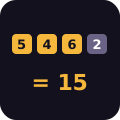
The classic way to create a character is to roll 4d6 drop lowest: four six sided dice, drop the lowest die and add the other three. Do it six times for six ability scores, then assign them to Strength, Dexterity, Constitution, Intelligence, Wisdom and Charisma.
Type 4d6dl1 and roll six times, or use the dedicated stat roller, which rolls all six at once, shows each modifier and also offers the standard array and 27 point buy. Ask your dungeon master which method the table uses before you roll stats.
Virtual dice roller vs physical dice

Speed is the point of digital dice and online dice rolling. A virtual dice roller adds up eight d6s instantly, applies the modifier, repeats the last roll with one tap and works when your group plays online over voice chat or a Discord server. It also helps new D&D players learn which die is which.
Physical dice need no battery and no screen. Real dice have the clatter in the tray and the moment the whole room leans in to watch a d20 land. Plenty of groups play with both: real dice for the d20 and an online tool to roll dice for big damage pools.
Either way, this dnd dice roller uses the browser's cryptographic random number source, so every face is fair.
Tips for game masters

- Save monster to-hit and damage formulas as saved rolls before the session, like 1d20+4 and 2d6+2, so dice rolling stays quick in combat and your dnd dice roller does the math.
- Roll damage for a group of identical monsters at once by typing the full number of dice, such as 6d6 for three goblins.
- Use d% for random encounter and loot tables, and keep the roll history open to settle any dispute later.
- Check the odds of a DC on the d20 page before you set it, so a key check is hard but fair.
Dice rolling odds at a glance

Every face of a single fair die is equally likely. Add two dice and totals bunch in the middle: 7 is the most common result on 2d6 at 6 in 36, while 2 and 12 are each 1 in 36. That is why big pools like 8d6 land near their average of 28 most of the time.
Questions
Is this DnD dice roller free?
Yes. It is free to use, with no ads and no sign up. Open the page in any browser and roll.
Is it a truly random dice roller?
Each roll draws random numbers from your browser's cryptographic generator (crypto.getRandomValues). Any value that would favor one face is thrown out and drawn again, so every face has the same chance.
How do I roll with advantage?
Pick Advantage, add a d20 and press Roll. The roller rolls two dice and keeps the higher die. You can also type 2d20kh1.
How many dice can I roll at once?
Up to 100 dice in one roll, with up to 1000 sides each. Tap buttons hold up to 20 of each die.
Where are my past rolls kept?
Your last 50 roll results and up to 20 saved rolls live in your browser's local storage on this device. Nothing goes to a server. Clear history wipes the log.
Can I share a roll with my group?
Yes. After a roll, press Copy share link. Anyone who opens it gets the same notation, rolled fresh for them.
Does it work for other tabletop games?
Yes. The notation works for most tabletop RPGs and board games that use standard polyhedral dice. Daggerheart players can type 2d12 for the Hope and Fear dice and read each die.
How is this different from the Google dice roller?
The Google dice roller is handy for a quick d20. This one adds typed notation, drop and keep rules, advantage, saved rolls and a log of past rolls built for a full session of dice rolling.
Have another question? The full dice roller FAQ covers notation, stat rolling, dice odds and privacy, and the about page explains how each roll is generated.